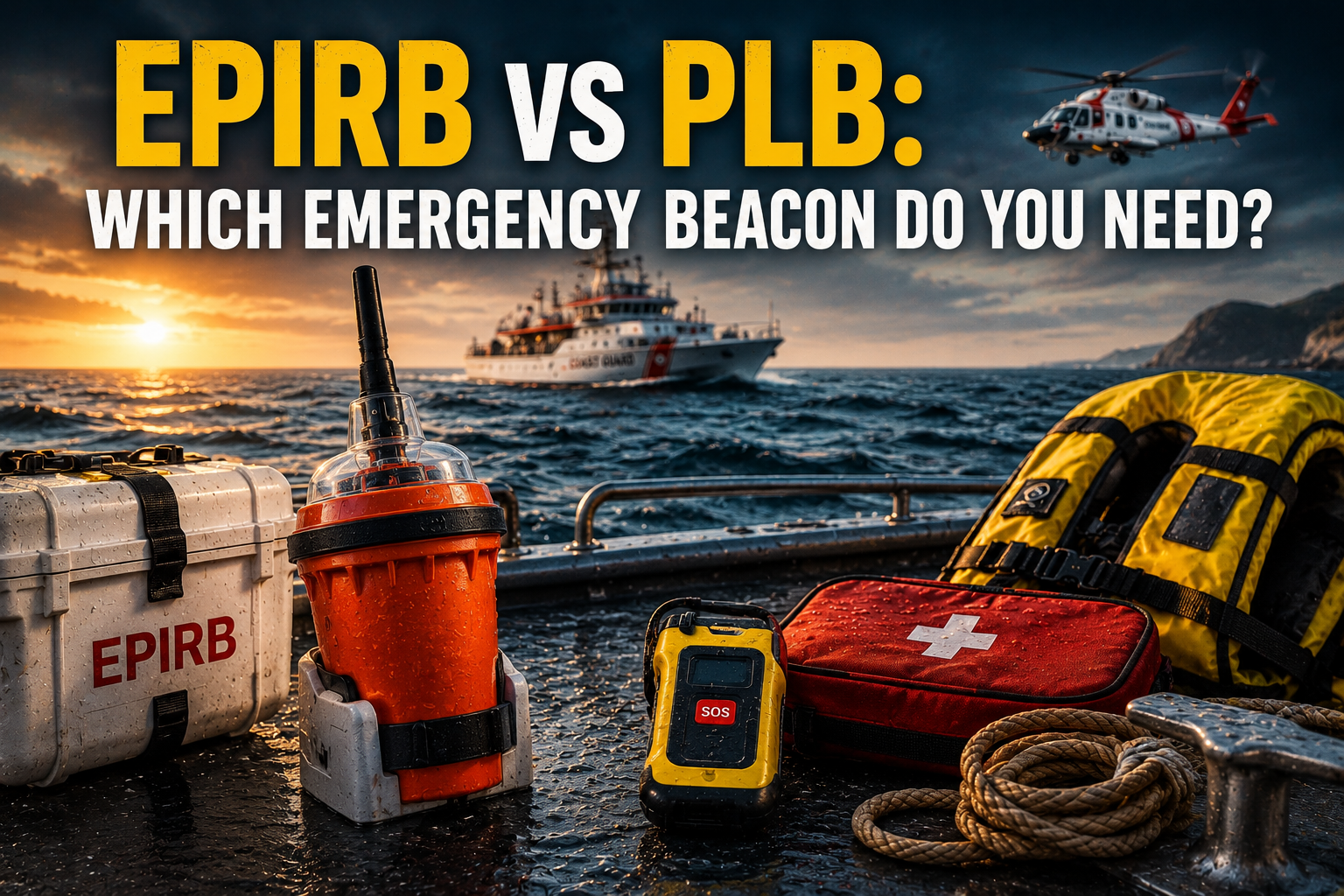
You’re Miles Offshore. Something Goes Wrong. Now What?
That’s not hypothetical for Florida boaters. It’s a real situation that happens every season. You need to know before you leave the dock which emergency beacon belongs to your boat. The EPIRB vs PLB question isn’t just a gear debate. It’s a safety decision that could affect how fast rescue teams find you.
Both beacons transmit distress signals via satellite. But they work differently, and they’re built in different situations. Getting this wrong isn’t just inconvenient. It can cost you time when time is the only thing that matters.
EPIRB: Built for the Boat, Not Just the Person
An EPIRB (Emergency Position Indicating Radio Beacon) is designed to stay on the vessel. Most models mount near the helm or in a bracket close to the cockpit. Some automatically activate when they hit saltwater. Others require manual activation. Either way, it starts transmitting your location fast.
For offshore fishing boats, sailing vessels, and anyone running more than 20 miles out, an EPIRB is usually the right call. It has a longer battery life than a PLB, typically 48 hours of continuous transmission versus a PLB’s 24-hour life. That window matters when you’re dealing with rough seas, fog, or a nighttime emergency far from shore.
Registration is non-negotiable with an EPIRB. Your beacon must be linked to your vessel for information, contact details, and emergency contacts in the official NOAA database. Without proper registration, rescue teams are working with partial information. That slows everything down.
And yes, buoyancy is built in. Most EPIRBs float. If your boat is going down fast, that matters.
PLB: Personal, Portable, and Seriously Underrated
A PLB (Personal Locator Beacon) goes with the person, not the boat. You clip it to your life jacket, your gear bag, or your belt. When something goes wrong, you activate it manually. It sends your GPS coordinates to search and rescue within minutes.
PLBs are popular with kayakers, paddleboarders, solo anglers, and anyone spending time on smaller vessels. They’re also a solid backup option even if you already carry an EPIRB. If you go overboard and the boat drifts away, that EPIRB isn’t helping you directly anymore. Your PLB is.
Battery life on a PLB runs around 24 hours. Shorter than an EPIRB, but still long enough for rescue teams to find you in most scenarios. The key difference is that activation is always manual. There’s no auto-deployment. You have to press the button yourself.
Registration works the same way linked to you personally through the NOAA beacon registration system. If the beacon activates, rescuers know exactly who they’re looking for. Keep that info updated. Phone numbers change. Boats change. Registration details should be included.
EPIRB vs PLB: The Real Differences Side by Side
Here’s where boaters get confused in the EPIRB vs PLB comparison. Both transmit the same frequency of 406 MHz, and both connect to the Cospas-Sarsat satellite network. So, on paper, they look similar. But the details matter.
EPIRBs are larger and vessel mounted. They’re best for offshore boats where the vessel itself needs to be tracked. Buoyancy is a standard feature. Battery life hits 48 hours. Auto-activation is available depending on the model.
PLBs are compact and personal. They go wherever you go. They don’t float on their own in most cases, so they need to stay attached to you or your gear. Battery life is around 24 hours. Activation is always manual.
For Florida boaters running offshore, an EPIRB on the boat and a PLB on your body is the strongest setup. It’s not either-or. It’s both when conditions demand it.
What Florida Conditions Actually Demand
Florida offshore fishing is not casual for lake boating. Gulf of America (AKA Gulf of Mexico) conditions shift fast. Atlantic (or Gulf if applicable) swells can show up with any surprise squall. If you’re running deep water trips out of Tampa Bay, Clearwater, or the Keys, you need serious backup equipment.
The activation process for both beacons is designed to be simple. That’s intentional. When things go sideways offshore, you’re not reading a manual. You’re reacting. EPIRBs that auto-deploy take even that decision out of the equation.
Battery life becomes a real factor during multi-day trips or when weather delays a rescue window. A 48-hour EPIRB transmission window gives rescue crews more time to work with. That matters.
And buoyancy isn’t just a technical spec. It’s the difference between a beacon still transmitting on the surface and one sitting on the ocean floor.
Don’t Skip Registration. Ever.
This is where a lot of boat owners drop the ball. They buy the beacon, store it onboard, and never complete registration. Or they update their boat but forget to update the registration attached to the beacon.
Both the EPIRB and PLB require registration through NOAA. It’s free. The official site is beaconregistration.noaa.gov. No fees. No payment is required. If anyone asks you to pay for beacon registration, that’s a scam report to [email protected].
Registration only takes a few minutes. And it’s the step that connects your signal to your name, your boat, and someone who can call for help on your behalf. Don’t skip it.
FAQ
- What is the main difference between an EPIRB and a PLB?
An EPIRB is mounted on the vessel and can activate automatically when submerged in water. A PLB is a personal device worn or carried by an individual and always requires manual activation. Both transmit 406 MHz to the same satellite rescue network, but EPIRBs have longer battery life and are designed for the boat, while PLBs are designed for the person. - Do I need to register both an EPIRB and a PLB?
Yes, both beacons require registration through the NOAA beacon registration database at beaconregistration.noaa.gov. Registration is free and links your beacon to your personal details, vessel information, and emergency contacts. Without it, rescue teams have significantly less information when your signal is activated. - How long does the battery last on an EPIRB vs PLB?
An EPIRB typically provides 48 hours of continuous transmission. A PLB provides around 24 hours. Both battery life windows are designed to give search and rescue teams enough time to locate you. Always check your battery expiration date before offshore trips and replace it before it lapses. - Can I use a PLB instead of an EPIRB on my offshore boat?
You can, but it’s not the best approach for offshore boating. A PLB stays with you personally and requires manual activation. An EPIRB stays on the vessel and can auto-activate if the boat sinks. For serious offshore use in Florida, carrying both is the safest option one for the boat, one for the person. - Does an EPIRB float?
Most EPIRBs are designed with buoyancy built in. They float when deployed, which keeps the beacon transmitting on the surface even if the vessel has sunk. Most PLBs do not float on their own, so they should be kept attached to your person or life jacket at all times.