Boating in Florida feels easy when conditions cooperate. Warm air. Open water. Familiar coastlines.
But offshore, conditions do not ask permission before changing. When something goes wrong, distance matters. And time matters more than most boaters realize. Out in the Gulf, help does not need to be nearby. It needs to be found.
That is where modern marine safety technology changes outcomes.
EPIRBs and VHF radios do not make rescues dramatic. They make them efficient. And efficiency offshore is often the difference between a controlled response and a widening emergency.
Offshore Emergencies Are Rare Until They Aren’t
Most offshore rescues do not start with panic. They start with something simple.
· A mechanical issue
· A weather shift that arrives earlier than expected
· A boat that will not restart
Florida boaters know this pattern well. A few weeks ago, two boaters were rescued nearly 40 miles off Tarpon Springs after their vessel became disabled. The conditions were not extreme. But the distance worked against them. Without the right equipment, that situation could have unfolded very differently.
Along Florida’s coast, these rescues happen quietly and regularly. The common factor is not luck. It is preparedness, which results in faster response speed.
In offshore conditions, a disabled vessel can drift quickly once propulsion is lost. As time passes, uncertainty grows and the search area expands.
EPIRBs and VHF radios remove that uncertainty at the moment it matters most. They do not wait for visibility. They do not rely on someone spotting you. They reduce the search, before it starts.
Why EPIRBs Change How Rescues Begin
An EPIRB does one job exceptionally well. It tells rescuers exactly where you are.
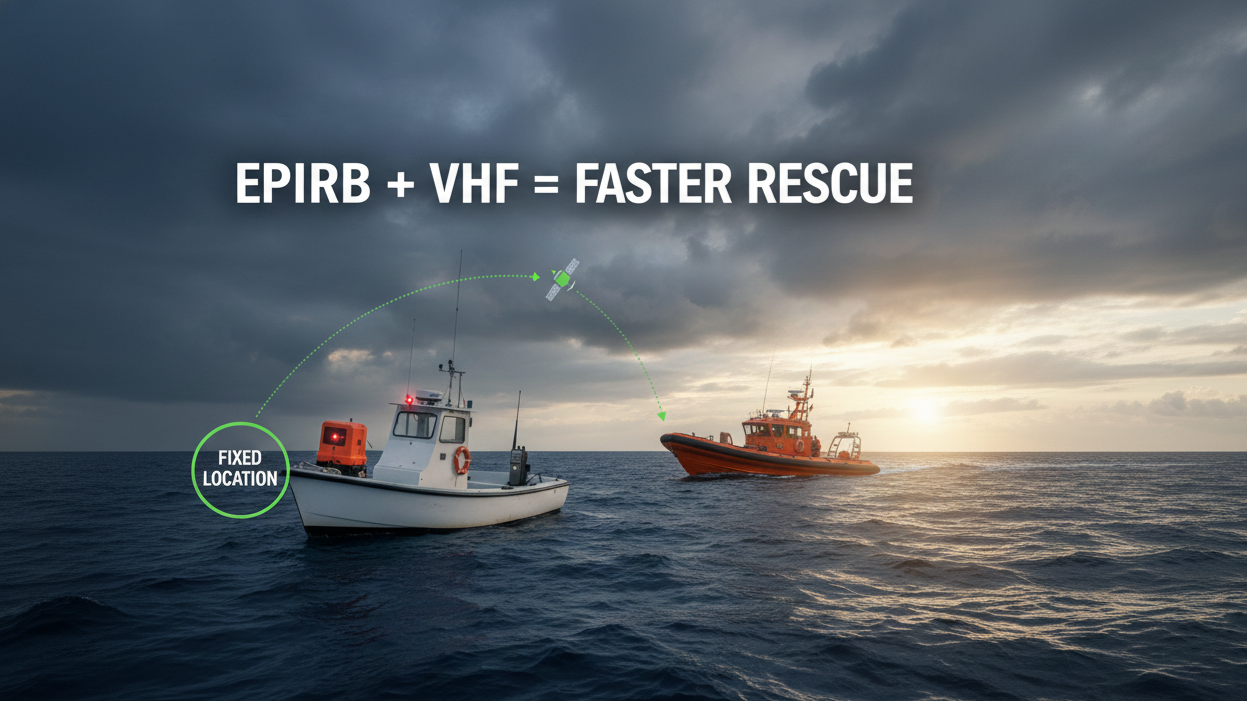
Once activated, it transmits a distress signal directly to satellite systems. No cellular coverage is involved. No range limitations apply. The signal repeats until it is received and acted on. That clarity changes everything.
In Florida waters, storms build fast and visibility drops faster than most people expect. Boats lose power more often than social media suggests.
An EPIRB keeps transmitting even when everything else stops working:
1. Phones do not do that. 2. Navigation systems do not do that. 3. Most onboard electronics are not built for prolonged failure conditions.
EPIRBs are designed specifically for those moments: Water exposure. Impact. Extended activation time.
That design is why rescue coordination centers treat EPIRB alerts as immediate, high-priority events.
Why this matters: when an EPIRB is activated offshore, responders move toward a fixed location instead of searching for a widening area. That alone can shorten rescue timelines by hours.
Why VHF Radios Still Matter Offshore
VHF radios have not been replaced by newer technology. They remain essential because they work when conditions are unstable.
A VHF radio allows direct communication with the Coast Guard and with nearby vessels. No apps. No intermediary systems. Just open-channel voice communication. In many cases, communication begins before a situation becomes critical. Early contact often prevents escalation.
During active rescues, VHF radios provide real-time updates. Position clarification. Condition of reports. Clear instructions.
In Florida waters, boat density matters. Often, the closest assistance is not an aircraft or a cutter. It is another vessel within range that hears the call.
Modern VHF radios add another layer of speed. GPS-enabled distress alerts transmit position data automatically, reducing confusion during high-stress moments.
When used together, EPIRBs and VHF radios serve different stages of the same response. One initiates rescue when communication may no longer be possible. The other guides it while coordination still matters.
What We See When Preparation Is Missing
Most offshore incidents do not involve dramatic failure. They involve delays.
Boaters wait longer than they should. They assume someone will see them. They rely on equipment not designed for offshore conditions.
As time passes, options narrow. EPIRBs and VHF radios change that pattern by shifting the response earlier, when conditions are still manageable. That shift is often invisible to the people who make it home. But it is very visible to the teams’ coordinating rescues.
Preparation Offshore Is Not About Fear
Florida boating is not dangerous by default. But offshore boating is unforgiving of delay.
Modern rescue systems work best when they are activated early, not as a last resort. That is why preparation matters more than optimism.
EPIRBs and VHF radios are not accessories. They are core safety equipment for anyone operating offshore in Florida waters.
They do not guarantee rescue. They make one possible faster, clearer, and more controlled.
And when the shoreline disappears, that difference matters.